

Anthropic s Claude Managed Agents can now "dream," sort of
The story

Also, 5-hour usage limits will double for Pro and Max users of Claude Code.
From the source
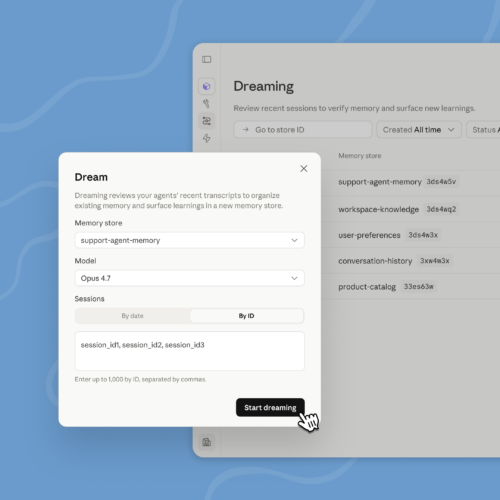
Text settings Story text Size Small Standard Large Width Standard Wide Links Standard Orange Subscribers only Learn more Minimize to nav SAN FRANCISCO—At its Code with Claude developers’ conference, Anthropic has introduced what it calls “dreaming” to Claude Managed Agents. Dreaming, in this case, is a process of going over recent events and identifying specific things that are worth storing in “memory” to inform future tasks and interactions.
Dreaming is a feature that is currently in research preview and limited to Managed Agents on the Claude Platform. Managed Agents are a higher-level alternative to building directly on the Messages API that Anthropic describes as a “pre-built, configurable agent harness that runs in managed infrastructure.” It’s intended for situations where you want multiple agents working on a task or project to some end point over several minutes or hours.
Anthropic describes dreaming as a scheduled process, in which sessions and memory stores are reviewed, and specific memories are curated. This is important because context windows are limited for LLMs, and important information can be lost over lengthy projects. On the chat side of things, many models use a process called compaction, whereby lengthy conversations are periodically analyzed, and the models attempt to remove irrelevant information from the context window while keeping what’s actually important for the ongoing conversation, project, or task.
Who and what
Key names and topics in this story: Anthropic, Claude Managed Agents.
Where to follow next
- Read the full piece at arstechnica.com
- More from our AI & prompts coverage

Related stories

How Anthropic’s Mythos has rewritten Firefox’s approach to cybersecurity
Security researchers at Mozilla say Anthropic's Mythos has unearthed a wealth of high-severity bugs in Firefox.
How to Build a Single-Cell RNA-seq Analysis Pipeline with Scanpy for PBMC Clustering, Annotation, and Trajectory Discovery
In this tutorial, we perform an advanced single-cell RNA-seq analysis workflow using Scanpy on the PBMC-3k benchmark dataset. We start by loading the dataset, inspecting its structure, and applying quality control checks to evaluate gene counts, total counts, mitochondrial conten

EMO: Pretraining mixture of experts for emergent modularity
A Blog post by Ai2 on Hugging Face

Meet GitHub Spec-Kit: An Open Source Toolkit for Spec-Driven Development with AI Coding Agents
If you have spent time using AI coding agents — GitHub Copilot, Claude Code, Gemini CLI — you have probably run into this situation: you describe what you want, the agent generates a block of code that looks correct, compiles, and then subtly misses the actual intent. This vibe-c