

Course correction: Google to link more sources in AI Overviews

The story
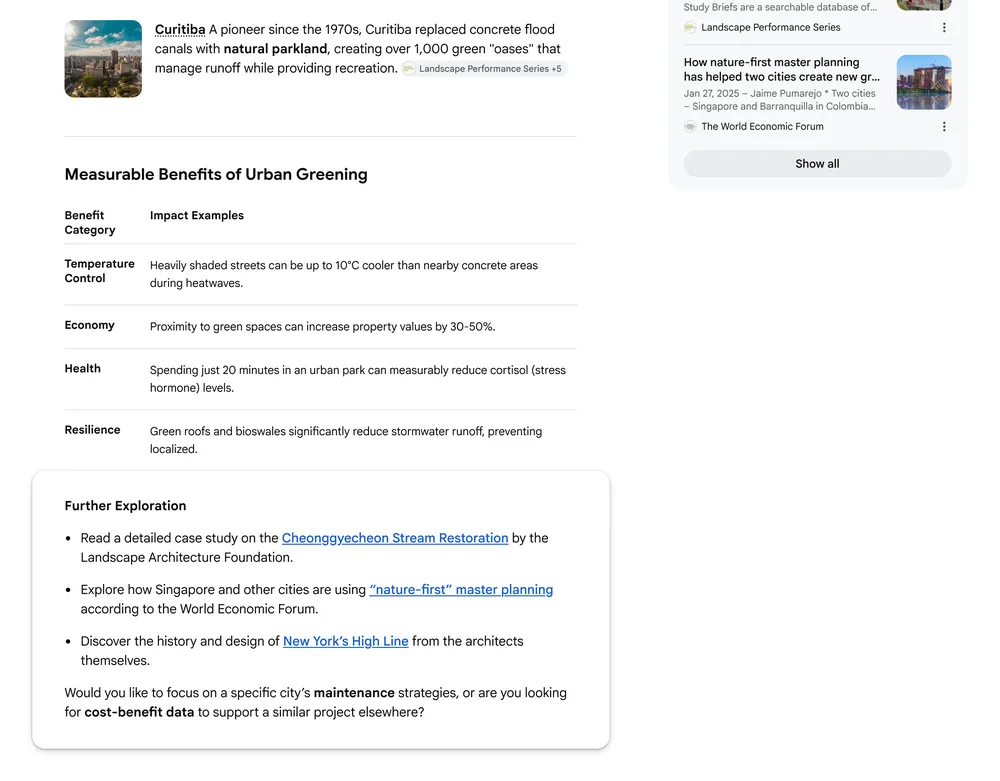
Google's AI search will start citing its sources in several new ways.
From the source
Text settings Story text Size Small Standard Large Width Standard Wide Links Standard Orange Subscribers only Learn more Minimize to nav The top of Google search page is prime real estate, but it has primarily been the domain of AI Overviews for the past two years. Websites that spent years optimizing for Google search haven’t exactly loved being pushed down the page by a chatbot and may blame AI Overviews for recent traffic drops. Google is not admitting fault, but it is rolling out a number of changes that will place more links to websites inside AI answers.
Google says many AI Overviews are “just the beginning of exploring a topic you’re interested in.” To support this supposed yearning to know more, AI Overviews and AI Mode will soon get a new section at the bottom called “Further Exploration.” The new exploration box will link to articles and analysis that is relevant to the query in a bullet point list. In the example below, a search for urban green spaces produces suggested links to content about specific projects in New York and Singapore. This is also where you may see the bait questions that are so common at the end of AI outputs.
Similarly, AI Overviews may include a section of “Expert Advice” that offers a snippet of content from around the web that is relevant to your search. This can include news and reviews from around the web, as well as discussions from public-facing forums and social media. Each one will include a link so you can “jump to the full conversation.”
Who and what
Key names and topics in this story: Course, Google, Overviews.
Where to follow next
- Read the full piece at arstechnica.com
- More from our AI & prompts coverage

Related stories

Google unveils screenless Fitbit Air and Google Health app to replace Fitbit
The $100 Fitbit Air is available for preorder today.
How to Build a Single-Cell RNA-seq Analysis Pipeline with Scanpy for PBMC Clustering, Annotation, and Trajectory Discovery
In this tutorial, we perform an advanced single-cell RNA-seq analysis workflow using Scanpy on the PBMC-3k benchmark dataset. We start by loading the dataset, inspecting its structure, and applying quality control checks to evaluate gene counts, total counts, mitochondrial conten

EMO: Pretraining mixture of experts for emergent modularity
A Blog post by Ai2 on Hugging Face

Meet GitHub Spec-Kit: An Open Source Toolkit for Spec-Driven Development with AI Coding Agents
If you have spent time using AI coding agents — GitHub Copilot, Claude Code, Gemini CLI — you have probably run into this situation: you describe what you want, the agent generates a block of code that looks correct, compiles, and then subtly misses the actual intent. This vibe-c